

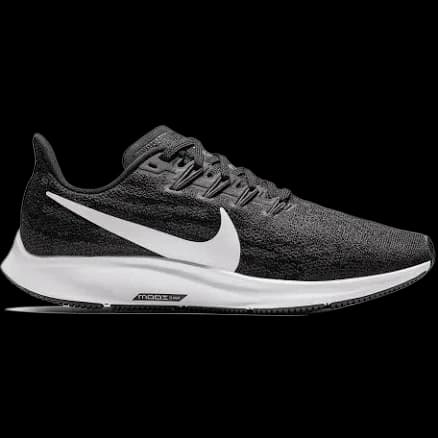
Lifespan: Nike Pegasus 36
~720 km~447 mi
Add the km they've run to start the count.Add the miles they've run to start the count.
See full data on the Pegasus 36
Buy, track or sell
No Pegasus 36 listed right now.
Be first in line — we'll email you the moment a pair in your size lists.
About the shoe
The Nike Pegasus 36 remains a dependable workhorse for runners who value comfort, breathability, and durability in a daily trainer. Its secure fit and versatile cushioning make it suitable for a wide range of workouts, though those seeking cutting-edge innovation may find it less exciting. For most runners, the Pegasus 36 offers a familiar, no-nonsense experience that gets the job done mile after mile.
Reports from 100+ mile tests and user feedback indicate the Pegasus 36 holds up well, with most wear being cosmetic rather than structural. The upper mesh and outsole show minimal premature wear, and the cushioning retains its responsiveness over time. Some minor outsole wear is noted, but overall longevity is above average for the category.
Full specs, fit notes, and reviews on the Nike Pegasus 36 wiki page.
Specs
252 g · 10 mm drop
Norma rating
8.5/10
The Nike Pegasus 36 is widely regarded by experts and users as a highly versatile daily trainer, praised for its balanced cushioning, moderate weight, and reliable durability. Its responsive yet not overly soft ride makes it ideal for everyday runs, base building, and general training, with nearly universal recommendations for this use case. The cushioning and fit are sufficient for most long runs, though some runners may prefer more plush or specialized shoes for marathon distances, hence a slightly lower suitability for extended efforts. For tempo runs, the Pegasus 36 is responsive enough for moderately hard efforts, but lacks the snappy, propulsive feel of dedicated tempo or racing shoes, making it a solid but not optimal choice. For racing, it is serviceable for non-elite runners in distances from 5K to marathon, but is outclassed by lighter, more aggressive models and modern 'supershoes'. Trail running is a weak point: the outsole and upper lack the grip and security needed for technical terrain, and expert reviews consistently recommend the Pegasus Trail or other trail-specific models instead. For recovery runs, the Pegasus 36's cushioning and smooth transition are highly rated, providing comfort and support for easy miles without being overly soft or unstable.
- Reliable cushioning delivers a smooth, comfortable ride for daily training and long runs
- Breathable mesh upper keeps feet cool and adapts well to different weather conditions
- Secure fit with Flywire cables provides confident lockdown, especially at faster paces
- Durable outsole offers strong traction and withstands high mileage without excessive wear
- Minimal updates from the previous version may disappoint runners seeking major improvements
- Cushioning, while comfortable, lacks the energetic bounce or advanced tech found in newer models
Best for and fit
Daily training
Ideal for Best suited for beginner to intermediate runners seeking a versatile, all-purpose trainer for road running, daily mileage, and occasional tempo work. Ideal for those who prioritize comfort, breathability, and durability over the latest performance technologies.
The Pegasus 36 offers a performance-oriented fit with a slimmer profile than its predecessor. The heel and midfoot are notably snug, enhancing lockdown but potentially tight for wide or high-volume feet. The toebox is less roomy than the Pegasus 35, so runners needing more space should consider the wide version. The shoe is well-suited for neutral runners seeking a responsive, moderately cushioned daily trainer without stability or motion control features.
Sizing: Generally fits true to size for most runners, with some users noting a slightly snugger fit compared to Pegasus 35, especially in the midfoot and toebox. Wide sizes are available for those needing extra room.
Against its category
600 km average373 mi average
Daily Trainer shoes in NORMA's database last between 320199 and 800 km497 mi across 653 models. At 720 km447 mi, the Nike Pegasus 36 sits in the upper half of that range.
Other versions and similar shoes
- Pegasus 35~720 km · 447 mi
- Pegasus 36~720 km · 447 mi
- Pegasus 37~750 km · 466 mi
- Pegasus 38~750 km · 466 mi
- Pegasus 39~750 km · 466 mi
- Pegasus 40~720 km · 447 mi
- Pegasus 41~640 km · 398 mi



Questions and guides
How many kilometres does the Nike Pegasus 36 last?
The Nike Pegasus 36 lasts about 720 km (447 miles), based on hand-researched wear data for this model. Your own mileage shifts with body weight, running surface, and how you use the shoe.
How many miles does the Nike Pegasus 36 last?
About 447 miles (720 km), based on hand-researched wear data for this model.
When should I replace the Nike Pegasus 36?
Start checking for wear around 432 km (60% of its lifespan). By 576 km the foam and outsole are usually noticeably degraded, and most runners retire the shoe between there and 720 km.
How does the Nike Pegasus 36 compare to other daily trainer shoes?
Daily Trainer shoes in NORMA's database range from 320 to 800 km across 653 models. At 720 km, the Nike Pegasus 36 sits in the upper half of that range.
Is a used Nike Pegasus 36 worth buying?
Often, yes. A pair with under 60% wear (roughly 432 km) still has real training life left. NORMA lists second-rotation running shoes, and sellers can add the miles they logged, so you can see how much life is left.