

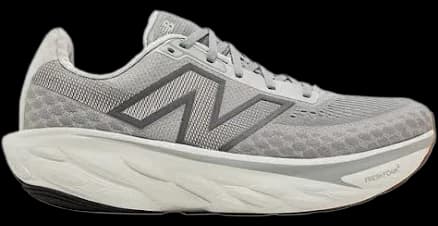
Lifespan: New Balance 1080 V14
~560 km~348 mi
Add the km they've run to start the count.Add the miles they've run to start the count.
See full data on the 1080 V14
Buy, track or sell
No 1080 V14 listed right now.
Be first in line — we'll email you the moment a pair in your size lists.
About the shoe
The New Balance Fresh Foam X 1080 v14 delivers a soft, stable, and highly cushioned ride that excels on easy runs and long training days. Its improved durability and versatile comfort make it a standout choice for runners seeking a reliable daily trainer, though those needing extra support or maximum breathability may want to look elsewhere.
Lab tests and long-term user reports indicate above-average durability for a max-cushion daily trainer. The toebox and outsole show minimal wear in controlled abrasion tests, and the outsole thickness has been increased for v14, further improving longevity. Some minor concerns exist about upper durability, but overall build quality is strong for the category.
Full specs, fit notes, and reviews on the New Balance 1080 V14 wiki page.
Specs
298 g · 6 mm drop
Norma rating
8.5/10
The New Balance Fresh Foam X 1080 v14 is widely regarded by experts and users as an outstanding choice for daily training and recovery runs due to its plush Fresh Foam X cushioning, comfort, and moderate stability. The shoe excels at easy and moderate paces, offering a soft yet slightly firmer ride than previous versions, which enhances stability for longer efforts. It is highly recommended for long runs, especially for runners prioritizing comfort and protection over speed, with several reviewers logging 15+ mile efforts comfortably. However, the shoe is not designed for tempo runs or racing: it lacks the responsiveness and energy return of dedicated speed shoes, and multiple testers found it difficult to pick up the pace or maintain threshold efforts. Its weight and soft midsole further limit its suitability for racing, especially at shorter distances. The 1080 v14 is not intended for trail running, as it lacks the necessary traction and support for technical terrain. User and expert consensus strongly positions it as a top-tier option for recovery runs, where its softness and protection shine.
- Exceptionally plush cushioning absorbs impact and reduces fatigue on long runs, making it ideal for recovery days and high-mileage training.
- The updated midsole geometry and wider platform provide a more stable ride than previous versions, offering confidence on uneven surfaces and during transitions.
- Durable outsole and reinforced upper materials extend the shoe’s lifespan, even with frequent use on varied terrain.
- Versatile enough for both running and all-day wear, thanks to its comfortable fit and stylish design.
- Ventilation is limited, causing the shoe to retain heat during warm weather or intense efforts.
- Heavier than some competitors in the daily trainer category, which may be noticeable for runners seeking a lightweight, race-oriented feel.
- Not recommended for runners who need significant arch support or motion control, as it is a neutral shoe.
Best for and fit
Recovery
Ideal for Best suited for beginner to experienced runners who prioritize comfort and shock absorption on daily runs, recovery sessions, or long distances. Ideal for neutral runners with average gait who want a reliable, versatile trainer for easy miles, walking, or standing for extended periods. Not recommended for those needing structured support or a lightweight, race-day shoe.
The v14 is more accessible to a wider range of runners than previous versions, but the toebox remains snug for those with wider feet or who prefer more toe splay. The shoe is best for daily training and recovery runs, offering plush, soft cushioning and a premium feel.
Sizing: Fits true to size according to both expert and user feedback. However, runners needing more toe splay may prefer 2E or 4E widths, as the standard toebox is on the snug side.
Against its category
610 km average379 mi average
Recovery shoes in NORMA's database last between 480298 and 800 km497 mi across 54 models. At 560 km348 mi, the New Balance 1080 V14 sits in the lower half of that range.
Other versions and similar shoes
Questions and guides
How many kilometres does the New Balance 1080 V14 last?
The New Balance 1080 V14 lasts about 560 km (348 miles), based on hand-researched wear data for this model. Your own mileage shifts with body weight, running surface, and how you use the shoe.
How many miles does the New Balance 1080 V14 last?
About 348 miles (560 km), based on hand-researched wear data for this model.
When should I replace the New Balance 1080 V14?
Start checking for wear around 336 km (60% of its lifespan). By 448 km the foam and outsole are usually noticeably degraded, and most runners retire the shoe between there and 560 km.
How does the New Balance 1080 V14 compare to other recovery shoes?
Recovery shoes in NORMA's database range from 480 to 800 km across 54 models. At 560 km, the New Balance 1080 V14 sits in the lower half of that range.
Is a used New Balance 1080 V14 worth buying?
Often, yes. A pair with under 60% wear (roughly 336 km) still has real training life left. NORMA lists second-rotation running shoes, and sellers can add the miles they logged, so you can see how much life is left.