

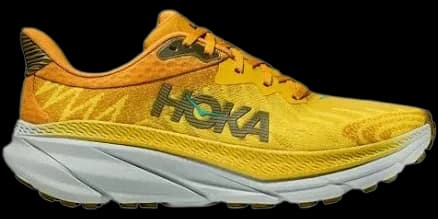
Lifespan: Hoka Challenger Atr 7
~560 km~348 mi
Add the km they've run to start the count.Add the miles they've run to start the count.
See full data on the Challenger ATR 7
Buy, track or sell
No Challenger ATR 7 listed right now.
Be first in line — we'll email you the moment a pair in your size lists.
About the shoe
The Hoka Challenger ATR 7 stands out as a highly versatile option for runners who split their miles between pavement and light to moderate trails. Its lightweight, cushioned design offers a smooth, stable ride and transitions seamlessly across mixed terrain, though it lacks the rugged protection needed for highly technical trails. Ideal for those seeking comfort and versatility in a single shoe.
Most testers report good upper and midsole longevity, but there are recurring concerns about the outsole rubber and lugs wearing faster than average, especially on pavement or rocky terrain. Some users have logged 300+ miles without major issues, but others note visible wear earlier.
Full specs, fit notes, and reviews on the Hoka Challenger Atr 7 wiki page.
Specs
252 g · 5 mm drop
Norma rating
8.5/10
The Hoka Challenger ATR 7 is widely praised for its versatility, comfort, and lightweight build, making it an excellent choice for daily training, especially for runners who mix road and light-to-moderate trail surfaces. Its cushioning and stability are sufficient for long runs, though some users note the midsole is more plush than responsive, which may not suit all for marathon distances but is generally well-received for extended efforts. The shoe is less suited for tempo runs and racing due to its moderate responsiveness and weight compared to dedicated speed shoes; it lacks the snappy ride and aggressive grip needed for fast paces or technical trail races. For trail running, it excels on mild to moderate terrain but is not recommended for highly technical trails due to limited protection and less aggressive lugs. Recovery runs are a strong use case, as the plush cushioning and smooth ride are gentle on tired legs. Expert consensus and user feedback consistently highlight its strengths as a hybrid daily trainer and recovery shoe for mixed surfaces, with limitations for technical terrain and race-day performance.
- Exceptionally lightweight build reduces fatigue on longer runs and makes transitions between road and trail feel effortless
- Plush cushioning and wide midsole platform deliver a stable, comfortable ride for mixed surfaces and longer distances
- Versatile outsole design provides reliable grip on gravel, dirt, and pavement, making it ideal for runners who mix road and trail routes
- Immediate step-in comfort with no break-in period required, appealing to runners who want a shoe ready out of the box
- Limited protection against sharp rocks and technical trail hazards due to minimal toe and sidewall reinforcement
- Forefoot fit may feel narrow for runners with wider feet, potentially causing discomfort on longer outings
- Outsole lugs tend to wear faster than more aggressive trail models, especially with frequent road use
Best for and fit
Daily training
Ideal for Best suited for beginner to intermediate runners who prioritize comfort and versatility, regularly run on a mix of roads and non-technical trails, and value a lightweight, cushioned shoe for daily training or long-distance efforts. Not recommended for those seeking maximum protection on rocky or highly technical terrain.
Best for runners with average or slightly narrow feet; wide-footed runners should consider the wide version. The shoe excels as a road-to-trail hybrid, offering a plush ride and secure fit for mixed surfaces. The forefoot/toebox may feel tight for some, especially on longer runs or in hot conditions. No carbon plate or stability posting; relies on stack height and foam for protection and comfort.
Sizing: Generally true to size for most runners, but some report the forefoot/toebox feels slightly narrow or constricting compared to other Hoka models. Wide versions are available for those needing more room.
Against its category
560 km average348 mi average
Trail shoes in NORMA's database last between 180112 and 850 km528 mi across 444 models. At 560 km348 mi, the Hoka Challenger Atr 7 sits in the upper half of that range.
Other versions and similar shoes
- Challenger ATR 5~570 km · 354 mi
- Challenger ATR 6~580 km · 360 mi
- Challenger ATR 7~560 km · 348 mi
Questions and guides
How many kilometres does the Hoka Challenger Atr 7 last?
The Hoka Challenger Atr 7 lasts about 560 km (348 miles), based on hand-researched wear data for this model. Your own mileage shifts with body weight, running surface, and how you use the shoe.
How many miles does the Hoka Challenger Atr 7 last?
About 348 miles (560 km), based on hand-researched wear data for this model.
When should I replace the Hoka Challenger Atr 7?
Start checking for wear around 336 km (60% of its lifespan). By 448 km the foam and outsole are usually noticeably degraded, and most runners retire the shoe between there and 560 km.
How does the Hoka Challenger Atr 7 compare to other trail shoes?
Trail shoes in NORMA's database range from 180 to 850 km across 444 models. At 560 km, the Hoka Challenger Atr 7 sits in the upper half of that range.
Is a used Hoka Challenger Atr 7 worth buying?
Often, yes. A pair with under 60% wear (roughly 336 km) still has real training life left. NORMA lists second-rotation running shoes, and sellers can add the miles they logged, so you can see how much life is left.